
Climate science
3 min read
The Carbon League: Top Emitters of Global Emissions
By Habiba Tariq
CO2 emissions are higher today than at any time in recorded human history. Human activity throughout the years has led humanity directly to this precarious and unprecedented state, which is adversely affecting our planet and environmental conditions. There have been decades of historic warnings, international summits, and programs aiming to grow public awareness, and still, the collective carbon footprint of countries around the world remains relentlessly high and continues to rise. This is not a door-knock warning; we are standing at this critical juncture this time.
Before we dive further, we must first unpack what a carbon footprint actually represents. The carbon footprint defines human activity through the lens of atmospheric impact, measuring the total quantity of greenhouse gases, primarily carbon dioxide and methane, generated by our daily choices, economic systems, and industrial infrastructure. It captures both direct emissions, such as burning fuel in an automobile, and indirect emissions, such as the electricity required to power home appliances or the supply chain energy needed to manufacture and transport consumer goods. When aggregated across billions of humans' daily activities and millions of factories worldwide, the carbon footprint appears to be the unmistakable strain on the biosphere.
Historical data give us an understanding of the relentless pace of global emissions over recent decades, culminating in a peak of 50.8 gigatons of carbon dioxide equivalent in 2023. While the overarching trend shows steady growth, there have been brief moments where emissions temporarily fell. Notably, in 2020, during the height of the COVID-19 pandemic, global emissions decreased by 5.4%. This represented the largest single-year drop in emissions recorded because of worldwide lockdowns, grounded commercial flights, reduced industrial manufacturing, as well as the drop in daily commuting. However, this temporary dip did not signify a structural shift toward sustainability. As health restrictions eased and economies reopened in 2021, global emissions hiked right back up, rapidly erasing the momentary atmospheric relief and returning to their upward trajectory.
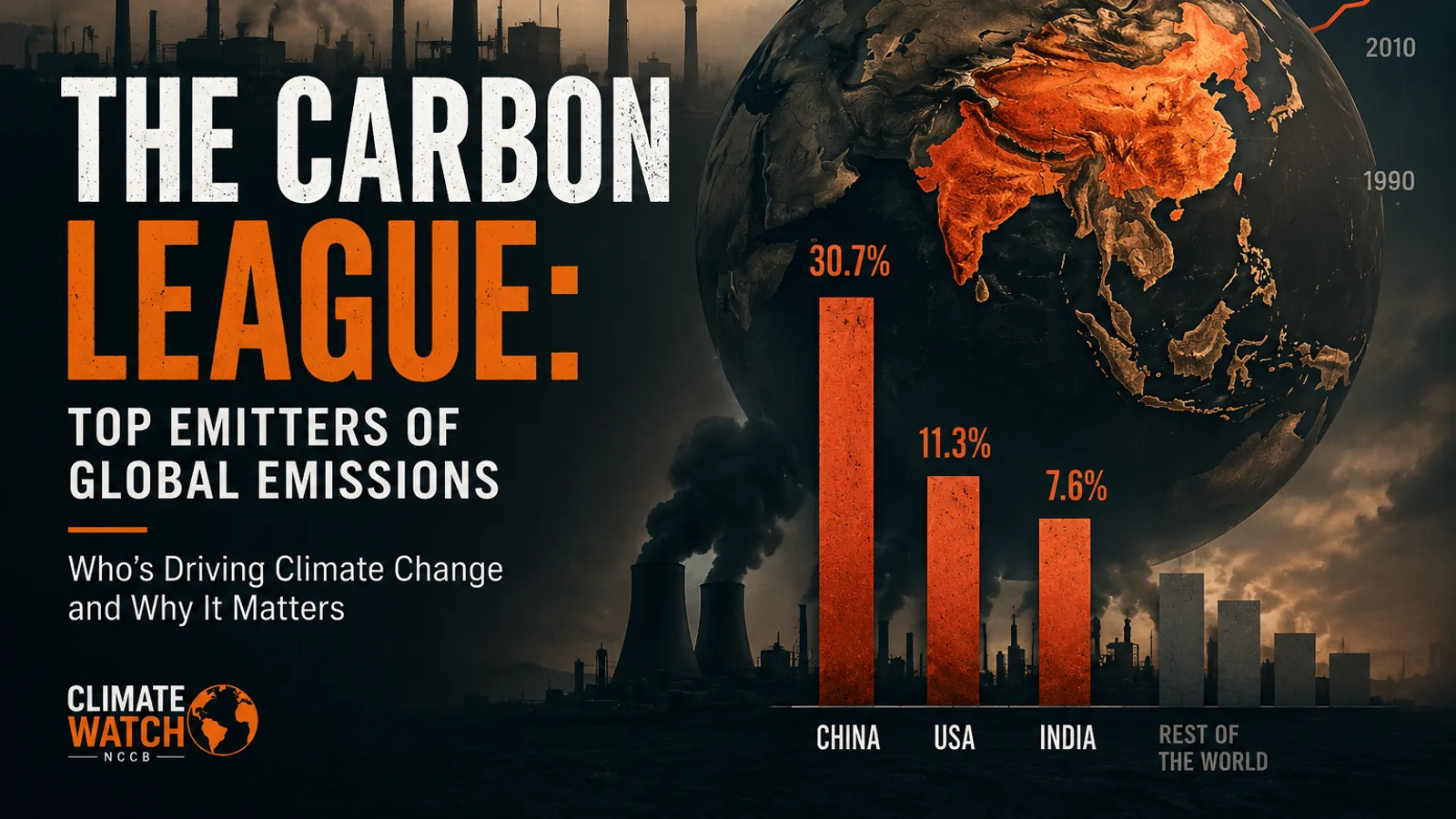
When examining the geographical distribution of global emissions, the burden is heavily concentrated among a small number of industrial powers. Out of all the nations in the world, the top ten emitting countries produce the vast majority of global carbon pollution, with just three giant nations. China, the United States, and India all together account for 42.6% of total global emissions. These three economic tycoons drive immense global demand for coal, oil, and natural gas to power their massive populations, industrial manufacturing hubs, and sprawling urban centers. Their dominant share of emissions underscores the reality that global climate stabilization is impossible without aggressive decarbonization policies within these few key nations.
The root cause of these rising emissions is specific human activities that generate the most pollution. Among all economic sectors, the energy sector is the biggest sector among all, acting as the primary driver of global climate change. In 2019, the energy sector was responsible for 76.7% of total global greenhouse gas emissions. This sector encompasses a wide variety of fundamental human operations, most notably the generation of heat and electricity, which relies heavily on burning fossil fuels like coal and natural gas. Beyond power plants, the energy sector includes the fuel consumed across the transport sector, including cars, trucks, ships, and airplanes, as well as the energy needed for heating, cooling, and powering commercial and residential buildings. Furthermore, the rest of the top sectors include agriculture at 12.3%, industrial processes make up 6.2%, and waste emissions are 3.8% of the global total.
The data explicitly shows that higher emissions are leading to higher economic growth for the countries producing them, but adversely affecting the whole world, especially the countries that are not contributing to it at all. This is the pattern countries have followed in the chase for economic growth since the Industrial Revolution. No matter how many international conferences, summits, and voices raised on this global catastrophe, results will only come once it becomes a priority for every soul on this planet.